


My best cricket accumulator ever was a four-fold during an IPL weekend: four match-winner selections, three of them favourites, one underdog that I backed because the pitch was a known spinner and the favoured side had no quality spin option. It paid 11/1. My worst was a five-fold where the first four legs landed and the final leg — an ODI between two evenly-matched sides — went down in the last over. Accumulators are the emotional extremes of cricket betting compressed into a single slip, and understanding how to build them without letting emotion drive selection is the difference between entertainment and strategy.
Approximately 7% of UK sports bettors wager on cricket, and a meaningful share of that activity flows through accumulator markets. The appeal is obvious — combining modest individual odds into a headline price that looks transformative. The challenge is equally obvious: every additional leg multiplies risk, and the margins bookmakers take on each selection compound across the acca.
Selecting Legs for a Cricket Accumulator
The temptation with cricket accas is to load up on heavy favourites because each individual leg “feels” safe. Four short-priced match winners at 1/3, 2/5, 1/2, and 4/9 combine to roughly 3.5/1 — a price that looks thin for the risk of four independent outcomes all needing to land. Heavy favourites lose cricket matches regularly, especially in T20 formats where a single explosive innings or a bowling spell of 4-15 can overturn any pre-match assessment.

I prefer a mix of conviction and value. Two legs where I have a strong analytical edge — a matchup I have studied, a venue I understand, a team selection that the market has not fully absorbed — paired with one or two legs where the odds overestimate the favourite and the underdog carries genuine value. That mix produces combined prices in the 6/1 to 15/1 range, which is where I want to operate: high enough to be meaningful if it lands, not so high that I am essentially buying a lottery ticket.

Fixture selection matters as much as side selection. T20 matches between closely-ranked sides are poor acca legs because they are genuinely close to 50/50 propositions, no matter what the odds suggest. Test matches and ODIs with clear form disparities, or T20s where one side has a pronounced home advantage on a familiar surface, make stronger legs because the favourite’s edge is structural rather than perceptual.
Correlation and Risk in Cricket Accas
Live betting accounts for approximately 30% of all online sports wagers in the UK. That figure matters for accumulators because it tells you how much of the market is reactive rather than predictive. Acca builders who select legs from matches spread across different days and competitions reduce the risk of a single shared variable — weather, for instance — sinking multiple legs simultaneously.
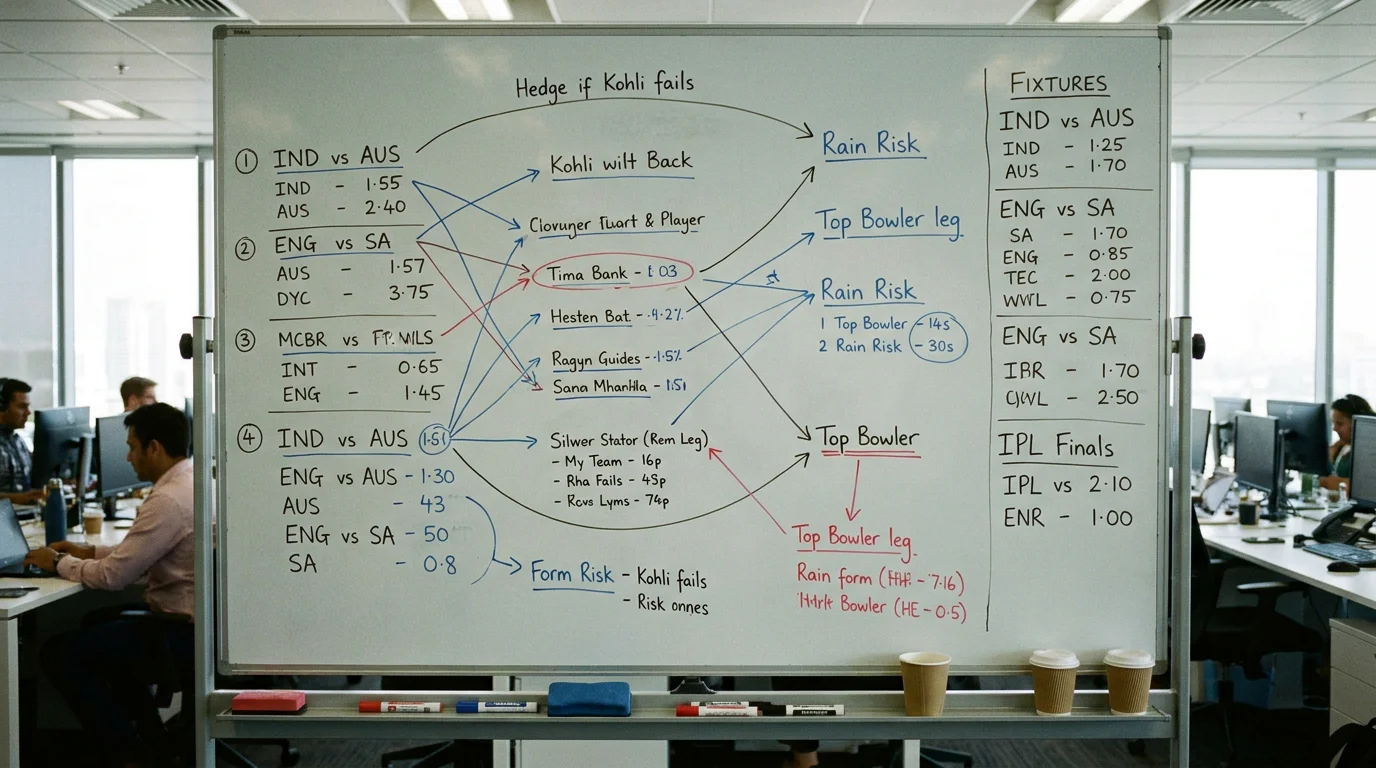
Correlated accas, where two or more legs are linked by a common factor, can work for you or against you. If you back two sides from the same franchise league on the same day and both are playing at the same venue in a double-header, a pitch that deteriorates faster than expected affects both legs. That is negative correlation you want to avoid. Conversely, if you identify that a specific set of conditions — dry weather, flat pitches across multiple venues — favours batting, an acca built around “over” total runs selections across different matches can capture that shared factor positively.
The key discipline is recognising when your legs are genuinely independent. Two IPL matches on the same evening at different venues with different conditions are effectively independent events. Two Test matches in the same series at the same ground a week apart are not — the pitch carries over, and the losing side’s confidence may be affected. True independence between legs is the foundation of a sound acca.
Acca Insurance and Acca Boost Offers
Michael Dugher, the founding CEO of the Betting and Gaming Council, described the betting industry as a “hugely significant contributor to the leisure industry, to sport and to the UK economy as a whole.” That scale means operators compete aggressively for accumulator business, and the most common competitive tools are acca insurance and acca boost promotions.

Acca insurance refunds your stake — typically as a free bet — if one leg of your accumulator lets you down and all others win. The catch is in the conditions: most operators require a minimum number of legs (usually four or five) and minimum odds per leg (usually 1/5 or 1/4). These conditions are designed to exclude the short-priced, low-margin accas that are most likely to trigger the insurance. The practical effect is that acca insurance encourages you to build riskier accas with more legs and longer individual prices — which is exactly what the bookmaker wants.

Acca boosts add a percentage to your winnings if all legs land. A 10% boost on a four-fold sounds attractive, but calculate the actual monetary value: a 10-pound stake at combined odds of 8/1 returns 80 pounds profit. A 10% boost adds 8 pounds. That is meaningful, but it does not change the expected value of the underlying bet. Use boosts as a bonus, not as a reason to build an acca you would not otherwise place.
Stake Sizing for Cricket Multis
Stake discipline is where most acca strategies break down. The temptation to increase stakes on a “banker” acca where every leg feels certain leads to exactly the kind of loss that erodes a betting bank. My rule is straightforward: accumulator stakes should never exceed 2% of my betting bank, regardless of confidence level. If my bank is 500 pounds, an acca gets a 10-pound stake at most.

The reason is mathematical. Even a three-fold acca of strong favourites has a probability of roughly 40-50% at best. A four-fold drops to 25-35%. At those probabilities, you need multiple winning accas to recover from a run of losers, and that only works if your losses are small enough to absorb. Flat staking — the same amount on every acca — removes the emotional bias that leads bettors to chase losses with larger stakes on subsequent accas.
I keep a separate tracking sheet for accas, distinct from my single-bet records. This allows me to evaluate whether my accumulator activity is profitable over time or whether it is a negative-expectation habit that I am subsidising with single-bet profits. After nine years, the honest answer is that accas are marginally profitable for me only because I restrict them to situations where I have a genuine edge on at least two of the legs. Without that edge, they would be a consistent drain. For a deeper understanding of how individual market mechanics influence each leg of your acca, cricket betting markets explained covers every market type in detail.
Articles
Created by the "cricketbettingwebsites.com" editorial team.
