

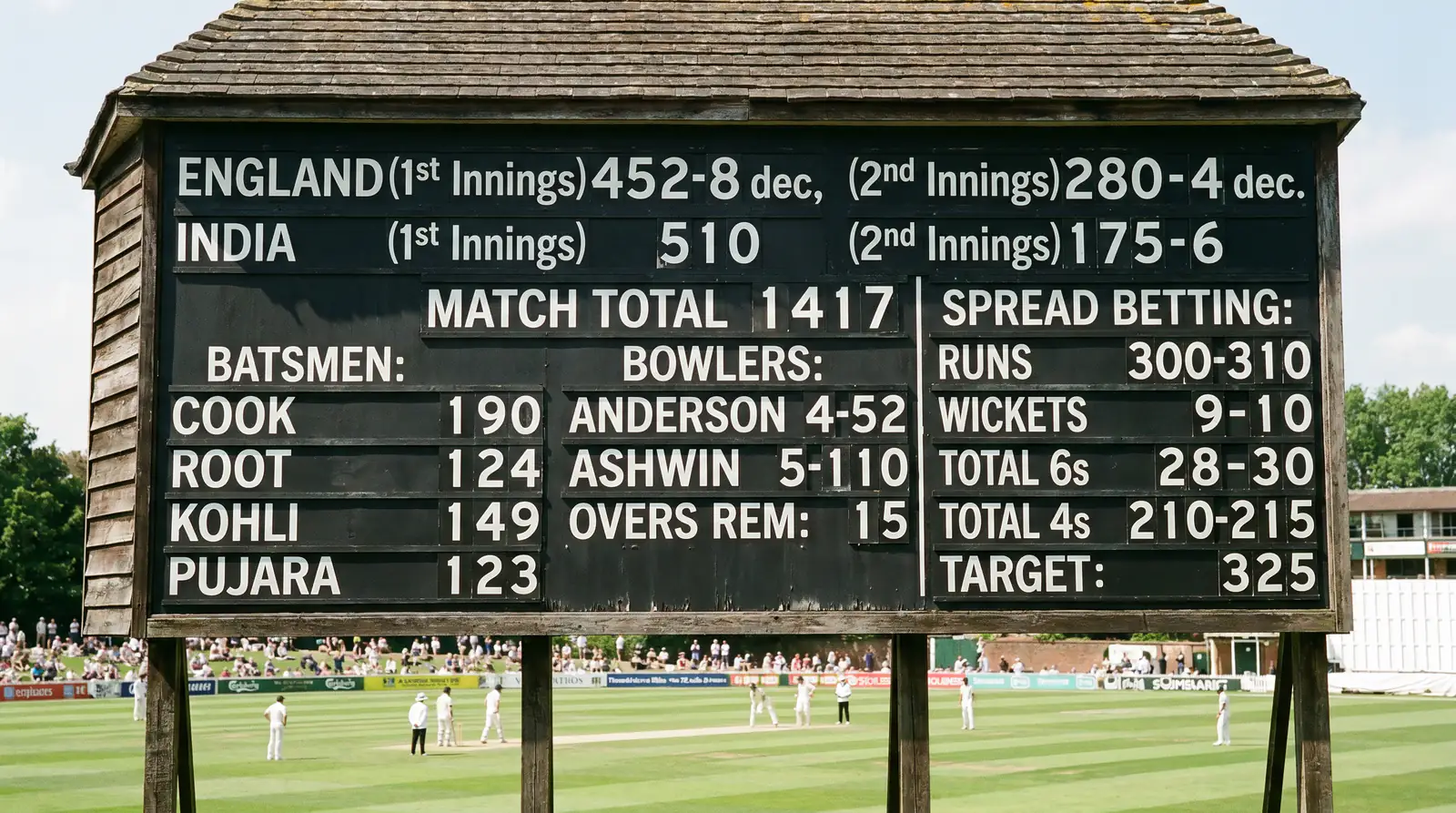
The first time I placed a cricket spread bet, I bought total runs at 285 for two pounds per run on a Test match in Rawalpindi. The final total was 823. That is 538 runs above my buy price, multiplied by two pounds per run. The profit was real, but so was the lesson: spread betting in cricket can produce returns that fixed-odds bets simply cannot match, and losses that are equally disproportionate.
Spread betting occupies a distinct niche within UK cricket wagering. It is not available on standard fixed-odds bookmakers — you need a specialist spread betting firm regulated under FCA rules rather than the UKGC alone. The mechanics are fundamentally different from backing a selection at fixed odds, and understanding those mechanics before you stake real money is not optional. It is essential.
How Cricket Spread Betting Works
The UK cricket betting market is worth approximately 52 million pounds annually, and while spread betting represents a small fraction of that total, it attracts a disproportionate share of sophisticated bettors. The principle is simple: the spread firm quotes a range — say, total runs in a match at 275-285 — and you decide whether the actual outcome will be higher (buy) or lower (sell) than that range.

If you buy at 285 for one pound per run and the match produces 320 runs, you profit 35 pounds (320 minus 285, times your stake). If the match produces 260 runs, you lose 25 pounds (285 minus 260, times your stake). The critical difference from fixed-odds betting is that your profit or loss scales with how far the outcome moves from your entry point. There is no cap on either side unless you use a stop-loss.
That scaling is what makes spread betting uniquely suited to cricket. In a sport where a Test match might produce anywhere from 400 to 1,500 runs across four or five innings, the range of outcomes is enormous. A T20 match might produce between 200 and 450 runs. The width of those possible outcomes is the playground of spread betting — and the source of its risk.
The “spread” itself — the gap between the buy and sell price — is the firm’s margin. A tighter spread means less margin for the firm and better value for the bettor. Comparing spreads across firms for the same market is the spread-betting equivalent of shopping for the best fixed odds.
Common Cricket Spread Markets
Total match runs is the headline market, but it is not the only one. Run supremacy — the margin of victory expressed in runs — is popular for limited-overs matches. If Team A wins by 45 runs and you bought the supremacy at 15, you profit on the 30-run difference. If you sold and Team A only won by 5, you profit on the 10-run difference.
Individual batsman runs are another staple. The spread firm quotes a range for a specific player — say, Joe Root at 35-40 in a Test innings — and you buy or sell. This market rewards deep knowledge of individual form, matchups against specific bowling attacks, and venue scoring patterns. I use it most during Ashes series, where I have enough data on the key players’ records at specific grounds to form views that differ from the quoted spread.
Wicket-related spreads include total wickets in a session, total wickets falling to pace versus spin, and individual bowler wickets. These are lower-range markets — a bowler might take between 0 and 7 wickets in a match — which means the per-point stakes need to be sized carefully. A two-pound-per-wicket stake on a bowler who takes 0 when you bought at 2.5 costs you only five pounds. But a ten-pound-per-wicket stake on the same outcome costs 25 pounds. Scale matters.
Managing Downside Risk in Spread Betting
Live betting makes up between 55 and 60% of all cricket wagers in the UK, and spread betting is inherently a live product. Your position changes with every ball bowled, every run scored, every wicket that falls. The ability to close out a position — effectively cashing out by selling what you bought, or buying back what you sold — is the primary risk management tool.

Stop-losses are the second tool. A stop-loss caps your maximum loss at a predetermined level. If you buy total runs at 285 with a stop-loss at 255, your maximum loss is 30 times your per-run stake. Without a stop-loss, a rain-affected match that produces 180 runs would cost you 105 times your stake — a figure that can exceed your account balance if you are not careful.

I never trade cricket spreads without a stop-loss in place. The potential for extreme outcomes — a Test match where one side is bowled out twice in two days, or a T20 where both sides score 220-plus — makes uncapped exposure genuinely dangerous. The stop-loss reduces your potential profit slightly, because the firm adjusts the quoted spread to account for the cap, but the trade-off is worth it for the protection against catastrophic loss.
Position sizing is the third element. I allocate no more than 5% of my spread betting bank to any single position. Because the outcome range in cricket is wide, even a modest per-point stake can produce significant swings. Keeping individual positions small relative to the bank allows you to absorb losing trades without compromising your ability to continue trading.
Where to Access Cricket Spread Markets in the UK
Spread betting on cricket is available through FCA-regulated firms that specialise in financial and sports spread markets. These firms are distinct from UKGC-licensed fixed-odds bookmakers, though some operate under both licences. The regulatory framework for spread betting treats it as a financial product, which means client money segregation rules and conduct-of-business standards apply.

The number of firms offering cricket spreads is smaller than the number of fixed-odds bookmakers — you are looking at a handful of specialists rather than dozens of generalists. That limited competition means spreads are not always as tight as fixed-odds markets, and shopping between firms is critical for value. The market depth also varies by competition: Ashes Tests and IPL matches attract tighter spreads and more responsive pricing, while domestic county cricket and associate-member internationals may have wider spreads or no coverage at all.
If you are transitioning from fixed-odds cricket betting to spread betting, start with the total runs market on a format you understand well. Track how the quoted spread relates to the actual outcome across a dozen matches before staking real money. That calibration exercise will give you an intuitive sense of how wide the range of outcomes truly is — and it will almost certainly be wider than you expect. For a comparison with another alternative to traditional fixed-odds wagering, cricket betting exchange explains how peer-to-peer markets offer a different kind of pricing advantage.
Articles
Prepared by the cricketbettingwebsites.com editorial staff.
