

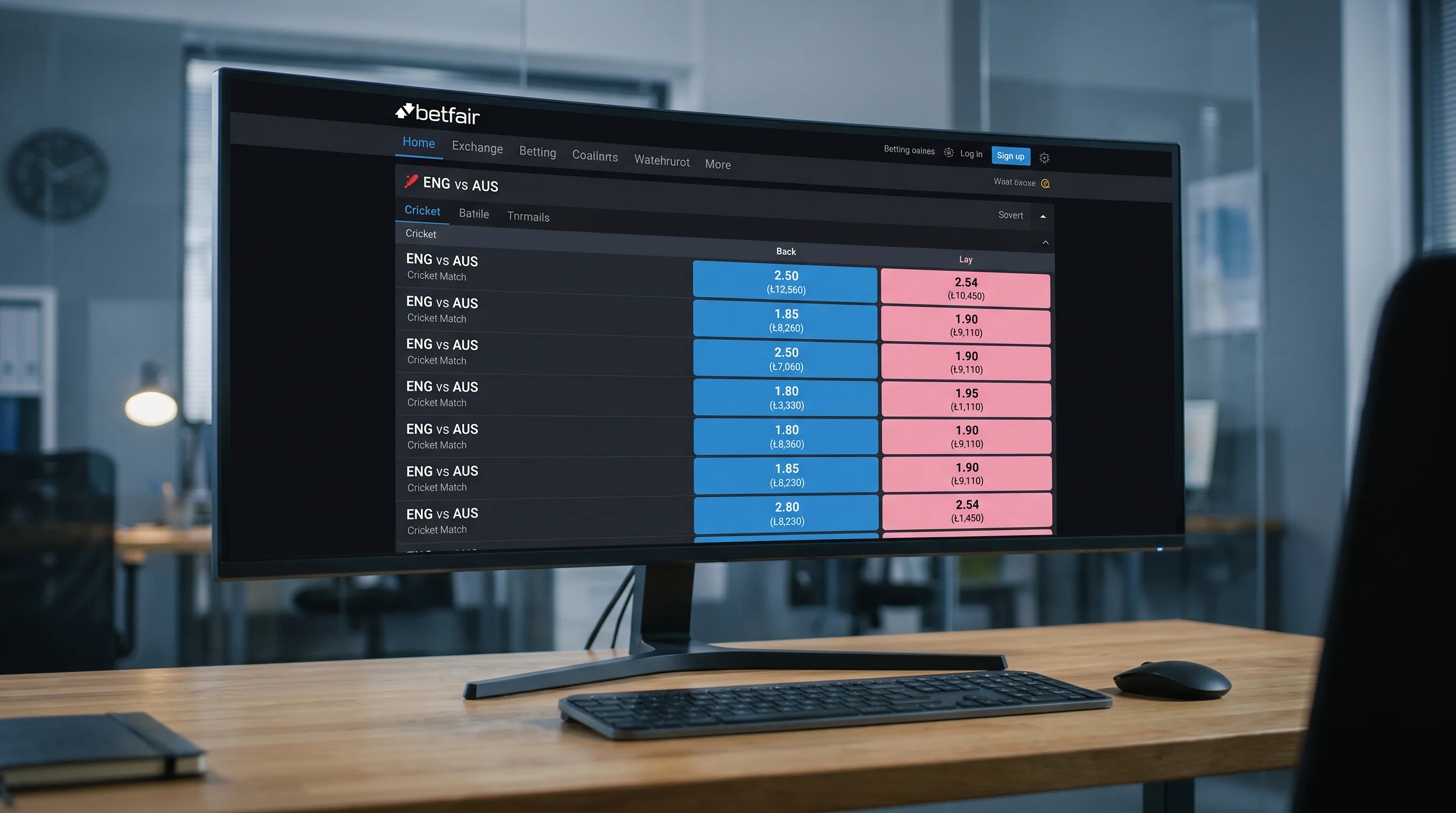
About 10% of the UK population actively participates in online sports betting. Most of them use traditional bookmakers without ever considering the alternative that sits right alongside those platforms: the betting exchange. Exchanges operate on a fundamentally different model — instead of betting against a bookmaker, you bet against other punters — and for cricket, that difference translates into better prices, more flexible positions, and a level of control that fixed-odds platforms simply do not offer.
I started using exchanges for cricket in 2019 after growing frustrated with the margins on match-winner odds for county cricket fixtures. The bookmaker was offering 4/5 on both sides of a match that was essentially a coin toss. On the exchange, I could back at 1.95 (roughly 19/20) or lay at 2.05. The difference sounds small until you compound it across hundreds of bets over a season. Exchange pricing consistently beats traditional bookmaker pricing on cricket, and understanding why is the first step toward using exchanges effectively.
Backing and Laying on a Cricket Exchange
Backing on an exchange works identically to placing a bet with a bookmaker: you select a team or outcome, choose your stake, and if your selection wins, you collect your winnings. The difference is that the other side of your bet is taken by another punter rather than by the exchange itself.
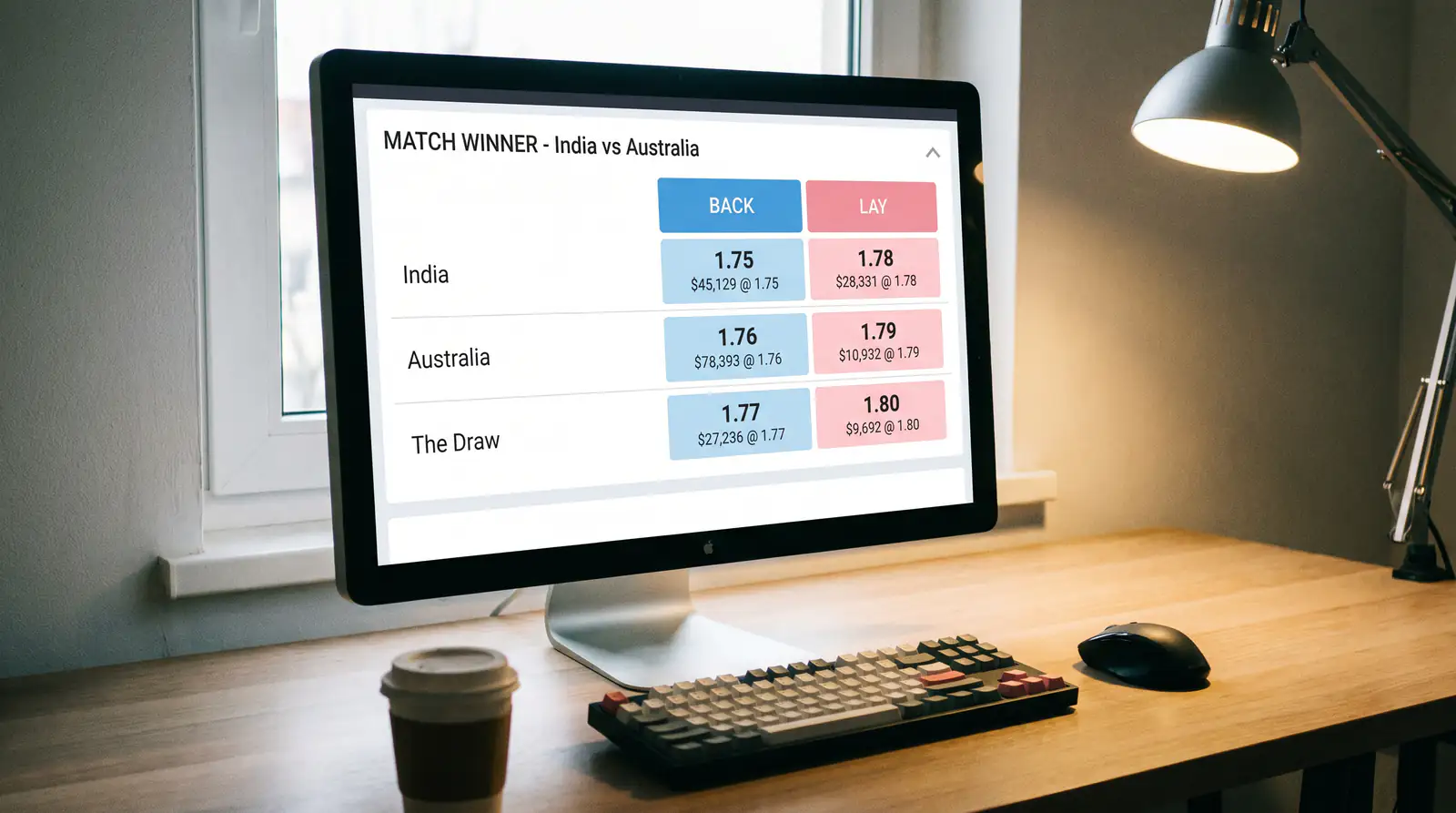
Laying is the exchange’s distinctive feature. When you lay a selection, you are betting against it. If someone wants to back Team A at 2.0 for ten pounds, and you lay that bet, you are accepting ten pounds of risk. If Team A wins, you pay the backer ten pounds profit. If Team A loses, you collect their ten-pound stake. You are, in effect, acting as the bookmaker for that specific market position.
This two-sided market is what produces better prices. On a traditional bookmaker, the margin is built into every price — both sides of a two-way market add up to more than 100% implied probability, and the difference is the bookmaker’s profit. On an exchange, the prices are set by supply and demand between bettors. The exchange takes its profit through a flat commission on net winnings rather than through inflated odds. That commission — typically between 2% and 5% — is almost always less than the margin embedded in bookmaker odds, which is why exchange prices are usually better.

The practical implication is straightforward: if you are betting on cricket match winners regularly, you will pay less margin on an exchange than with a traditional bookmaker. Over a season of 50 or 100 bets, that margin saving compounds into a material difference in your overall return.
Why Exchange Odds Often Beat Bookmaker Prices
William Hill and bet365 together capture over 50% of the click share in UK sports betting search advertising. That dominance reflects their marketing spend, not necessarily their pricing quality. Exchange odds frequently beat traditional bookmaker prices on cricket because the exchange model eliminates the structural overround that bookmakers embed in their odds.

To illustrate: a bookmaker might price a T20 match at 4/5 each side, implying a combined probability of 111%. The 11% above 100% is the bookmaker’s margin. On an exchange for the same match, the back price might be 1.98 and the lay price 2.02, implying a combined probability of roughly 101%. The exchange’s margin is dramatically lower, and the commission on winnings — say 2% — still leaves you ahead compared to the bookmaker’s embedded overround.
Where this advantage is most visible is in less liquid cricket markets. County Championship matches, associate-member internationals, and women’s cricket fixtures carry wider margins on traditional bookmakers because the operators are less confident in their pricing and compensate with higher margins. On exchanges, these markets are thinner in volume but the prices are set by bettors with specific knowledge, which can produce odds that are both sharper and more reflective of true probability.
Liquidity in Cricket Exchange Markets
Liquidity — the amount of money available to be matched at a given price — is the exchange’s Achilles heel for cricket. Football dominates exchange liquidity because it dominates the UK betting market. Cricket events get substantially less matched volume, and that affects your ability to get your full stake matched at the price you want.

IPL matches and Ashes Tests attract the deepest cricket liquidity on exchanges. During an IPL evening fixture, you can typically get hundreds or even thousands of pounds matched on the match-winner market without moving the price. For a county cricket match on a Tuesday afternoon, you might struggle to get fifty pounds matched.

Thin liquidity means you need to be patient. Place your order at the price you want and wait for it to be matched, rather than accepting the currently available price. On exchanges, unmatched bets sit in the order book and may be filled as the match approaches and more bettors enter the market. I routinely place cricket exchange orders 24 hours before a match and find them matched by the time play begins.
In-play liquidity is stronger than pre-match liquidity for most cricket matches, because many exchange users prefer to trade live. If you want to use the exchange for live betting, the volume is typically sufficient for major fixtures. For minor ones, the in-play exchange market may be too thin to trade effectively.
Understanding Exchange Commission
Exchange commission is charged on your net winnings in a market, not on every bet. If you back a team at 2.0 for ten pounds and win, your gross profit is ten pounds. At a 5% commission rate, you pay 50 pence, and your net profit is 9.50 pounds. If you lose, you pay no commission — it only applies to winning positions.

Commission rates vary by exchange and can be reduced based on your betting volume. High-volume bettors typically negotiate lower rates, sometimes down to 2%. Over a season of cricket betting, the difference between 5% and 2% commission is significant. A bettor placing 200 winning bets with average profits of 20 pounds each would save 1,200 pounds in commission at 2% versus 5%.
One nuance that catches new exchange users: the commission is on net winnings per market, not per bet. If you back and lay within the same market — a common trading strategy — the commission applies only to your net profit from all positions in that market. This makes trading strategies (backing at one price and laying at a shorter price after the odds move) more efficient than they would be if commission were charged on each transaction separately. For a comparison of odds quality across the broader UK market, best cricket odds comparison examines how exchange and bookmaker prices stack up across different cricket events.
Articles
Created by the "cricketbettingwebsites.com" editorial team.
