


The first cricket bet builder I ever assembled had four legs: match winner, top batsman, over 280 total runs, and a boundary to be hit off the first ball. It paid 34/1 and missed by one leg — the first ball was a dot. That near-miss hooked me on a market type that has since become one of the most popular features on UK sportsbooks, and for good reason. Bet builders let you construct a thesis about a match, combine correlated and uncorrelated outcomes into a single stake, and back your reading of the game in a way that no single market allows.
Cricket accounts for roughly 8% of global sports betting revenue, and bet builders have contributed to that share by turning passive match-watchers into active analysts. When you build a custom bet, you are forced to think about how different markets interact — whether a high-scoring match makes top batsman picks more or less predictable, whether the conditions favour bowlers enough to push the total under a certain line. That analytical process is what makes bet builders rewarding, even when the payout does not land.
How a Cricket Bet Builder Works
A bet builder — sometimes called a same-game multi or same-game parlay — combines multiple selections from a single match into one wager. All legs must win for the bet to pay out. The bookmaker calculates a combined price based on the individual odds of each leg, adjusted for any correlation between selections.
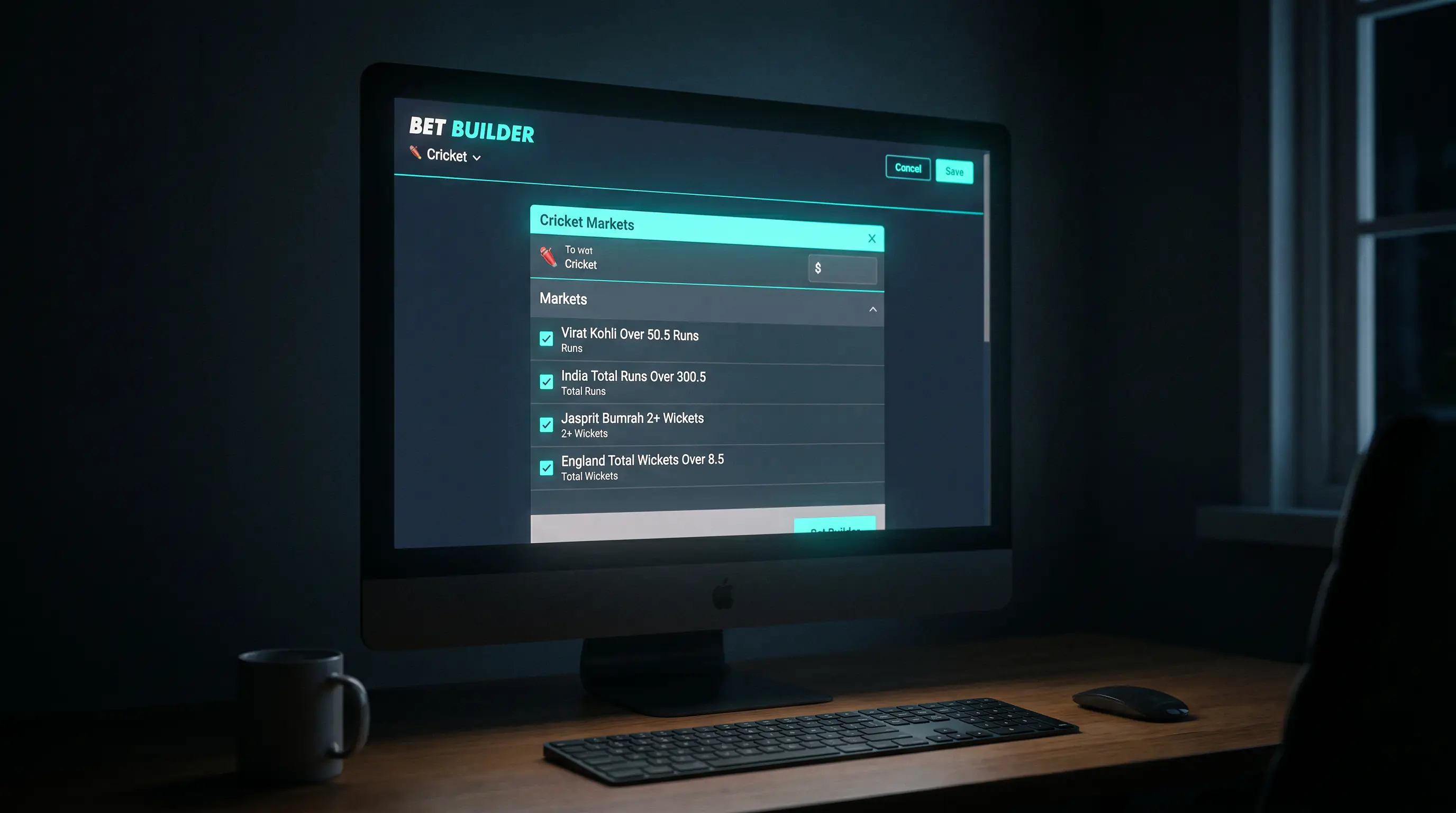
That correlation adjustment is where things get interesting. If you select “match winner: Team A” and “top batsman: Player X from Team A,” those outcomes are positively correlated — if Team A wins, their batsmen are more likely to have scored runs. The bookmaker’s algorithm accounts for this and offers a lower combined price than you would get by simply multiplying the individual odds together. Understanding this adjustment is essential because it directly affects the value of your bet builder. A four-leg builder where all selections are positively correlated will offer a shorter combined price than a four-leg builder where some selections are independent or negatively correlated.
The mechanics on most platforms are straightforward. You navigate to the match, toggle the bet builder feature, and start selecting markets. Each selection appears in a combined slip, and the price updates in real time as you add or remove legs. Most operators allow between two and twelve legs, though the practical sweet spot for cricket is three to five. Beyond five legs, the probability of all selections landing drops sharply, and the prices — while visually impressive — reflect that low probability accurately.

Effective Leg Combinations for Cricket
Not all leg combinations are created equal. I have tested dozens of approaches over the years and settled on a framework that prioritises controlled variance over speculative long shots.
The anchor-plus-edge approach works best for me. Start with a high-probability anchor — match winner in a lopsided fixture, or total runs over a low line on a batting-friendly surface. That anchor does not add much to the price, but it reduces the number of variables that need to go right. Then add one or two edge legs: a top batsman pick based on recent form and favourable matchup, or a runs-in-the-powerplay line that reflects venue-specific data. The anchor stabilises; the edges add the value.

Correlated legs can work in your favour when the correlation is strong but underpriced. For example, if you expect a low-scoring match on a green pitch — total under 250 combined runs and top bowler from the team with the best seam attack — the correlation between a low total and a seam bowler taking wickets is positive and logical. Some algorithms undervalue this connection, especially in less popular cricket fixtures where the pricing models have less historical data to calibrate against.
Avoid combining legs that are essentially the same bet expressed differently. “Team A to win” and “Team A highest opening partnership” are highly correlated but do not add meaningful information to your thesis. You are paying the correlation penalty twice for what amounts to a single view.
Availability of Cricket Bet Builders on UK Sites
Live in-play cricket betting makes up between 55 and 60% of all cricket wagers placed in the UK — a figure that underscores how central real-time wagering has become. Bet builders are primarily a pre-match product, though some operators now allow bet builder construction during the first innings of a limited-overs match, with markets adjusting dynamically.

Availability varies by operator and by competition. IPL, The Ashes, The Hundred, T20 World Cup, and most high-profile bilateral T20 series are covered by bet builders on all major UK platforms. Domestic competitions like the County Championship or T20 Blast have spottier coverage — some operators offer bet builders for these fixtures, others restrict the feature to international and franchise cricket.
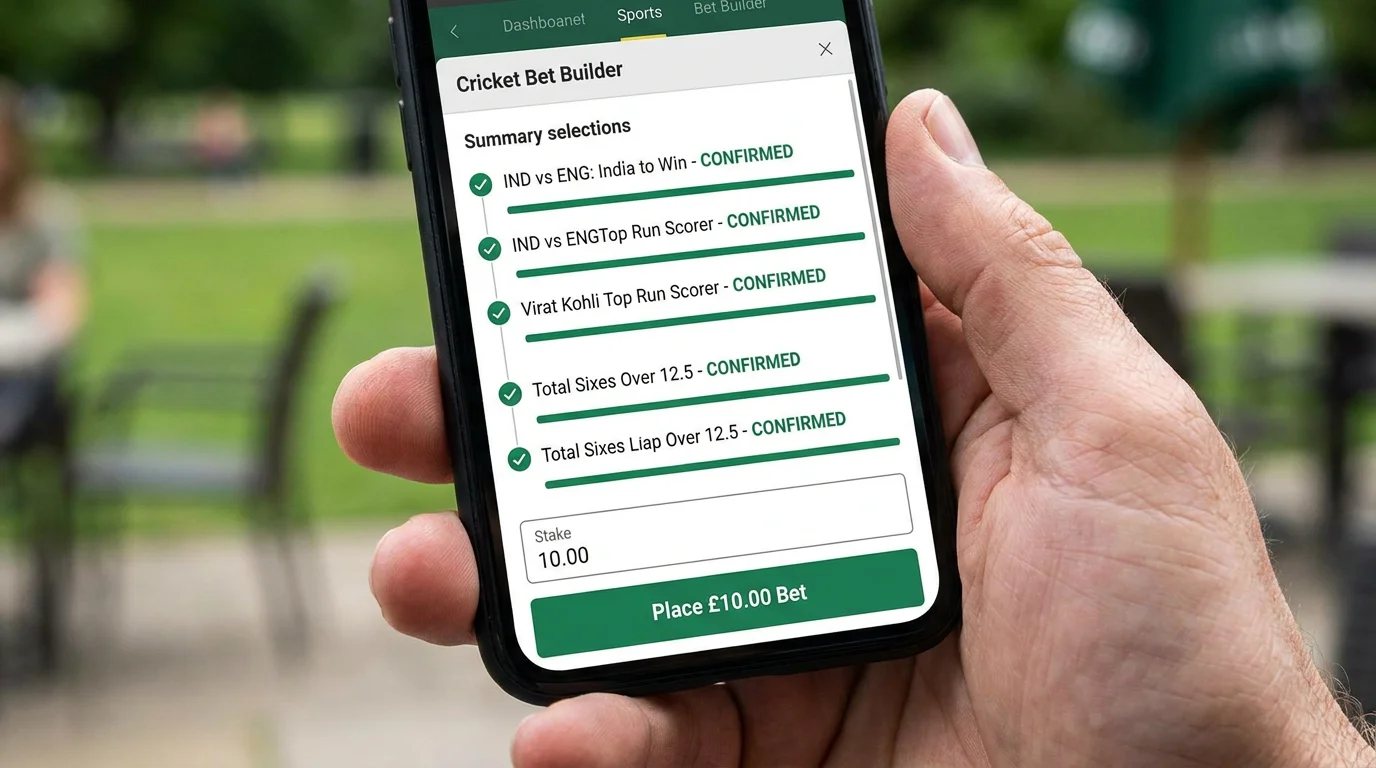
The number of markets available within the bet builder also varies. The best platforms offer 10 or more individual markets to combine: match winner, top batsman, top bowler, total runs, total sixes, total fours, player runs, player wickets, powerplay score, and first-over runs. Less comprehensive operators may limit you to match winner, total runs, and top batsman. More markets means more flexibility to build bespoke combinations that reflect your specific analysis of the fixture. For a related approach to combining multiple matches rather than multiple markets within one match, cricket accumulator tips covers the multi-match equivalent.
Bet Builder Pitfalls to Avoid
The most common mistake I see — and one I made early on — is treating bet builders as lottery tickets. Adding six or seven legs because the combined price looks exciting is a strategy with a negative expected return in the long run. Each additional leg multiplies the ways your bet can lose, and the bookmaker’s margin on each leg compounds. A five-leg builder at 20/1 is not five times more likely to lose than a single bet at 4/1; it is dramatically more likely to lose because each leg introduces an independent failure point.

Another pitfall is ignoring weather and pitch reports. A bet builder constructed the night before a match does not account for a morning inspection that reveals a damp pitch or an overcast forecast that was not in the original weather models. Cricket is uniquely weather-sensitive, and conditions on the day of the match should be the final check before confirming any builder.
Settlement rules for voided legs are worth understanding in advance. If one leg of your bet builder is voided — because a player is not in the starting eleven, or a match is reduced in overs — different operators handle it differently. Some settle the builder without the voided leg at reduced odds. Others void the entire bet. Knowing your operator’s policy before you place the bet saves frustration later.
Articles
Prepared by the cricketbettingwebsites.com editorial staff.
