

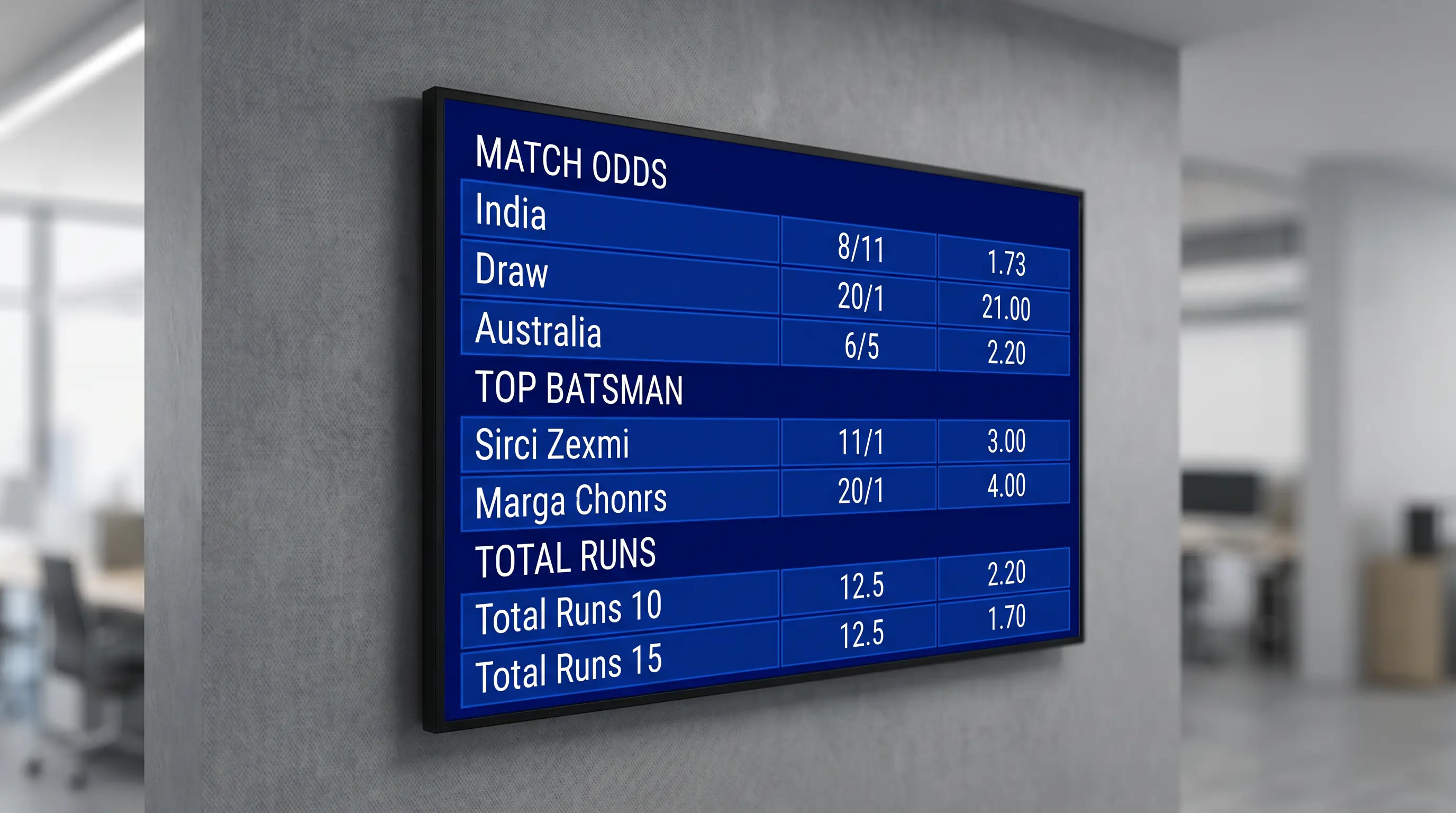
About 10% of the UK population actively participates in online sports betting, and every single one of them interacts with odds every time they open a sportsbook. Yet a surprising number of regular bettors cannot explain what odds actually represent beyond “the number that tells me how much I win.” Odds are prices. They encode probability, margin, and market opinion into a single figure, and learning to read them properly is the difference between betting with a plan and betting with hope.
I spent my first year of cricket betting treating odds as decoration on the bet slip. The team I fancied was 6/4, the other side was 4/5, and I picked the side I liked without understanding what those numbers meant in terms of implied probability or bookmaker margin. When I finally sat down and worked through the arithmetic, my hit rate did not change — but my staking and selection process transformed overnight. This guide covers the mechanics that made that shift possible.
Fractional Odds: The UK Standard
Fractional odds are the default on most UK sportsbooks and the format you will encounter first on any cricket match page. They express your potential profit relative to your stake. If a team is priced at 5/2, you stand to win five pounds for every two pounds staked. If they are priced at 1/4, you win one pound for every four pounds staked.
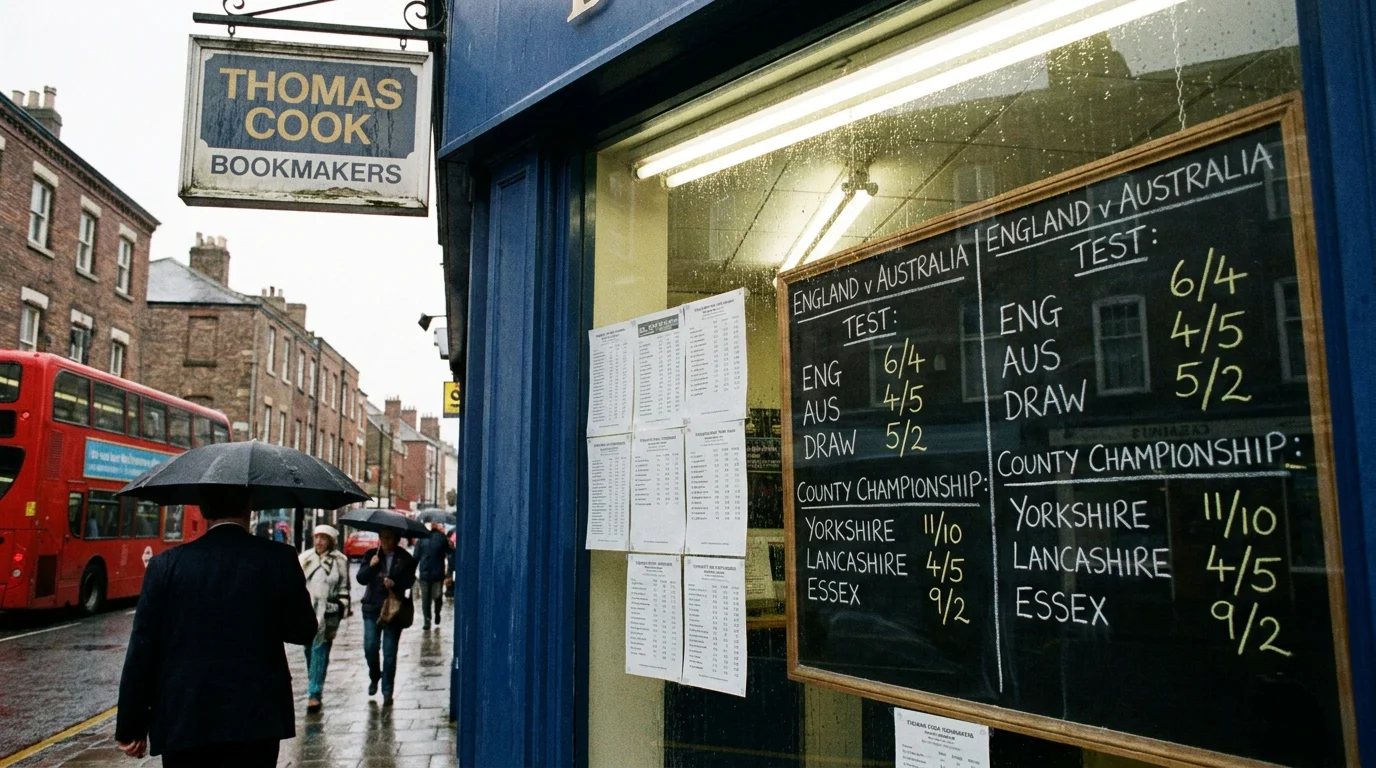
The intuitive read is straightforward: the larger the number on the left relative to the right, the bigger the payout and the less likely the bookmaker considers that outcome. An odds-on price — where the left number is smaller than the right, like 4/7 — signals a favourite. An odds-against price — where the left number is larger, like 7/2 — signals an underdog or less likely outcome.

Where fractional odds become genuinely useful is in quick mental comparison. If one bookmaker offers 9/4 on a match winner and another offers 2/1, you can see instantly that 9/4 is the better price without doing any conversion. For cricket, where match-winner odds tend to cluster in the 4/5 to 5/1 range, fractional odds provide a natural visual hierarchy that experienced bettors process at a glance.
One limitation: fractions do not compound neatly. If you are building an accumulator, multiplying 5/2 by 7/4 by 3/1 requires converting to decimals first, which leads to the next format.
Decimal Odds and Quick Conversion
Decimal odds represent the total return per unit staked, including your original stake. A price of 3.50 means you receive 3.50 pounds for every 1 pound wagered — 2.50 profit plus your 1 pound back. Converting from fractional to decimal is simple: divide the left number by the right number and add 1. So 5/2 becomes (5 divided by 2) plus 1, which equals 3.50.
Decimal odds are the standard across Europe and are increasingly popular with UK bettors who also wager on football or other international sports. For cricket, the advantage of decimals is precision. A price of 1.91 and a price of 1.95 are clearly different in decimal format; in fractional format, both might be displayed as “10/11” or “19/20,” and the distinction requires closer reading.

Accumulators are where decimals shine. To calculate the combined odds of a four-fold acca, multiply the four decimal prices together. If your four legs are priced at 1.80, 2.10, 1.65, and 2.40, the combined price is 1.80 times 2.10 times 1.65 times 2.40, which equals 14.97. A one-pound stake returns 14.97 pounds. Try doing that with 4/5, 11/10, 13/20, and 7/5 in fractional format — the arithmetic is far less elegant.
Implied Probability and Overround
This is where odds stop being just numbers and start being analytical tools. Every set of odds implies a probability — the bookmaker’s assessment of how likely that outcome is. To calculate implied probability from decimal odds, divide 1 by the decimal price. A price of 2.00 implies a 50% probability (1 divided by 2.00). A price of 3.00 implies a 33.3% probability (1 divided by 3.00).

William Hill and bet365 together capture over 50% of the click share in UK sports betting search advertising, and both embed a margin — called the overround — into their odds. Here is how it works: in a two-way cricket market (say, a T20 match with no draw), the true probabilities of each side winning must add up to exactly 100%. If Team A has a genuine 55% chance and Team B has a 45% chance, fair prices would be 1.82 and 2.22 respectively. But a bookmaker does not offer fair prices — they offer prices that imply, say, 57% and 48%, which adds up to 105%. That extra 5% is the overround, and it is the bookmaker’s built-in profit margin.
Understanding overround is critical because it tells you how much you are paying to bet. An overround of 103% is competitive. An overround of 110% is expensive. You can calculate the overround for any cricket match by converting both sides’ odds to implied probabilities and adding them together. If the sum is significantly above 100%, the bookmaker is taking a large margin, and the prices are less favourable for the bettor.

I check the overround on every cricket market I consider betting on. If a T20 match has an overround above 106%, I look for a better price elsewhere. Over a season, the cumulative effect of betting at lower overrounds is substantial — it is the mathematical equivalent of paying less commission on every trade.
How and Why Cricket Odds Move
Odds are not static. They move from the moment a market opens until the match concludes, and understanding why they move is as important as understanding what they represent. In cricket, odds move for three main reasons: information, money, and conditions.
Information-driven movement happens when team news breaks, a key player is ruled out, or a playing surface is revealed on the morning of the match. When a side announces that their leading fast bowler has been rested for the fixture, the match-winner odds adjust within minutes. The speed of that adjustment depends on how many bettors are paying attention — international fixtures adjust almost instantly, while county cricket markets may take hours to reflect new information.
Money-driven movement happens when large stakes are placed on one side of the market, forcing the bookmaker to adjust prices to balance their liability. If a significant amount of money comes in on Team A, the bookmaker shortens Team A’s odds and lengthens Team B’s to attract money on the other side. This movement does not necessarily reflect new information — it reflects the weight of money.
Conditions-driven movement is uniquely important in cricket. A morning rain shower that was not in the forecast, a pitch inspection that reveals more grass than expected, or a shift in wind direction that will assist swing bowling — all of these change the playing conditions in ways that directly affect probabilities and odds. Bettors who monitor conditions on match day, rather than relying on prices set the night before, consistently find moments where the odds have not yet caught up with reality. For a practical guide on comparing odds across UK bookmakers, the odds comparison article covers tools and strategies for finding the best prices.
Articles
Prepared by the cricketbettingwebsites.com editorial staff.
